How to Build an AI Chatbot in 2026 (Step-by-Step Guide)
This guide walks through how to build an AI chatbot from first decision to production in 2026 — including the parts most tutorials skip: grounding the model in your own data, preventing hallucinated answers, testing properly, and knowing when to hand off to a human.
What You Need Before You Start Building
Before writing a single line of code or config, get four things clear:
1. A specific use case. "A chatbot for support" is not a spec. "Resolve order-status questions without a human agent" is. The more specific your use case, the better the chatbot you build.
2. The data it will rely on. Whether that is a help centre, an order management API, a product catalogue, or an internal knowledge base — audit it now. Outdated articles, undocumented APIs, and contradictory policy pages become chatbot failures later, regardless of how good the underlying model is.
3. A platform decision. Covered in the next section. Choose before building, not during.
4. A definition of done. Decide what success looks like before you build. Are you measuring ticket deflection? Resolution rate? Lead generation? Customer satisfaction score? The metric you choose shapes how you design every conversation — a bot optimised to avoid human handoff looks completely different from one optimised to actually solve the customer's problem.
That last point is where most first builds go wrong. Write it down before you start.
Choose Your Approach: No-Code, Low-Code, or From Scratch
The most important decision is how much you build yourself. Three paths exist:
| Approach | Skills Needed | Best For |
|---|---|---|
| No-code builder | None to minimal | FAQ bots, simple lead capture, fast pilots |
| Low-code framework | Some engineering | Production assistants that take real actions |
| From scratch | Full engineering team | Research, highly custom needs, learning |
The deciding question is simple: does the bot only need to answer questions, or does it need to actually do things — issue a refund, book an appointment, update an account?
If it only answers questions, a no-code builder may be enough. If it needs to take real actions, you want a framework where testable, controllable skills are first-class.
Step 1: Define the Use Case and Success Metric
Start narrow. Pull your real contact data, find the highest-volume, lowest-complexity job the bot can own, and make that the entire scope of version one.
Classic starting points:
- Order status inquiries
- Password resets
- Store hours and location questions
- Returns policy questions
- Appointment scheduling
Audit your data before committing. The bot is only as good as what it can retrieve and act on. A help centre full of outdated articles or a returns policy that lives in three contradictory documents will surface as bot failures no matter how capable the underlying model is. Fixing the data is unglamorous work and almost always worth doing first.
Write the success metric before building. It changes everything downstream:
- Measuring resolution → design confirmation steps that ask users whether their problem was actually solved
- Measuring deflection → you get a different bot, and not always a better one for the customer
- Measuring lead quality → design qualification flows, not just conversation length
Step 2: Design the Conversation
A conversation flow is the route a dialogue takes toward a goal. Designing it is most of the actual work in building a good chatbot.
Start with the happy path — the cleanest route from question to resolution. Then design for the messy reality around it.
Real users:
- Interrupt mid-flow to ask something else
- Give incomplete information
- Change their minds partway through
- Switch topics and come back
Example: Return an order
Happy path: 1. User provides order number 2. Bot checks return eligibility 3. Bot generates return label 4. Bot confirms resolution
Detours to design for:
- User does not have the order number handy
- Item is outside the return window
- User asks where their previous refund went mid-flow
- User changes their mind about the return after initiating it
Step 3: Choose Your LLM and Ground It in Your Data
A raw large language model does not know your return policy, your inventory, your pricing, or your specific business rules. Grounding fixes this.
Retrieval-augmented generation (RAG) retrieves relevant content from your own knowledge base and feeds it to the model at answer time. This does two things:
1. Broadens what the bot can answer by connecting it to your actual content 2. Reduces hallucination by anchoring answers to source documents rather than the model's training data
In practice, this means:
- Indexing your help centre, product documentation, and policy pages into a vector store
- Connecting the bot to that vector store so it retrieves relevant passages before answering
- Configuring the model to answer from retrieved content rather than generating freely
One key design principle: use the LLM where language understanding genuinely helps — interpreting free-form user input, handling unexpected phrasing — and use cheaper, deterministic logic everywhere else. Sending every turn through a frontier model is slow and expensive. Most production chatbots use a hybrid approach.
Grounding is also a safety decision. The more answers come from retrieved, source-controlled content, the less room there is for the model to invent something plausible but wrong.
Step 4: Build and Integrate
With your conversation design and grounding in place, the build splits into two paths depending on your approach.
No-Code Path
A visual builder lets conversation designers assemble and test chatbot flows without writing code. This removes the engineering bottleneck for routine changes and lets non-technical team members iterate on the conversation design directly.
Most no-code builders include:
- A drag-and-drop flow editor
- A built-in testing panel
- Pre-built integrations with common tools
Low-Code or From-Scratch Path
A code-first build gives you version control, automated testing, and precise control over what actions the bot can take.
The integration work is the substance of this path. A useful production chatbot connects to your real systems:
- Order management system for order status and returns
- CRM for customer history and account details
- Booking system for appointments
- Payment processor for refunds
Budget generously for integrations. A realistic ratio for a production bot is one week of conversation design to three weeks of backend integration work.
If voice is in scope, the pipeline adds:
- Speech recognition (speech-to-text) on the way in
- Text-to-speech on the way out
- Telephony integration for handling actual phone calls
One architectural rule worth following regardless of stack: let the model handle language interpretation, but have explicit, testable skills control what actually happens. This separation means the limits on what the bot can do are something you designed deliberately — not something you are hoping the model gets right every time.
Step 5: Test, Deploy, and Monitor
Test it like software. This is the single biggest difference between a prototype and a production chatbot.
Build a suite of real conversation transcripts — including the confused and hostile ones — and run them on every change the way developers run unit tests on every commit. Without a regression suite, every improvement risks breaking something else, and you find out from real users rather than from a CI pipeline.
What to include in your test suite:
- Happy path conversations for every skill
- Common detour scenarios you designed in Step 2
- Edge cases — empty inputs, very long inputs, abusive inputs
- Handoff scenarios — conversations that should escalate to a human
- Conversations from real users after launch (add failed sessions continuously)
- Cloud hosting: Easier to scale, faster to iterate, lower operational overhead
- On-premises or private cloud: Required for data residency in regulated industries like healthcare and finance
Monitoring after launch:
Track what is actually happening, not just whether the bot is running:
- Resolution rate — did the customer's problem actually get solved?
- Drop-off points — where in conversations do users abandon?
- Escalation reasons — what triggered handoffs to humans?
- User satisfaction — did customers leave satisfied or frustrated?
Feed failed and escalated conversations back into the test suite continuously. The same failure should never ship twice.
Why AI Chatbot Projects Fail
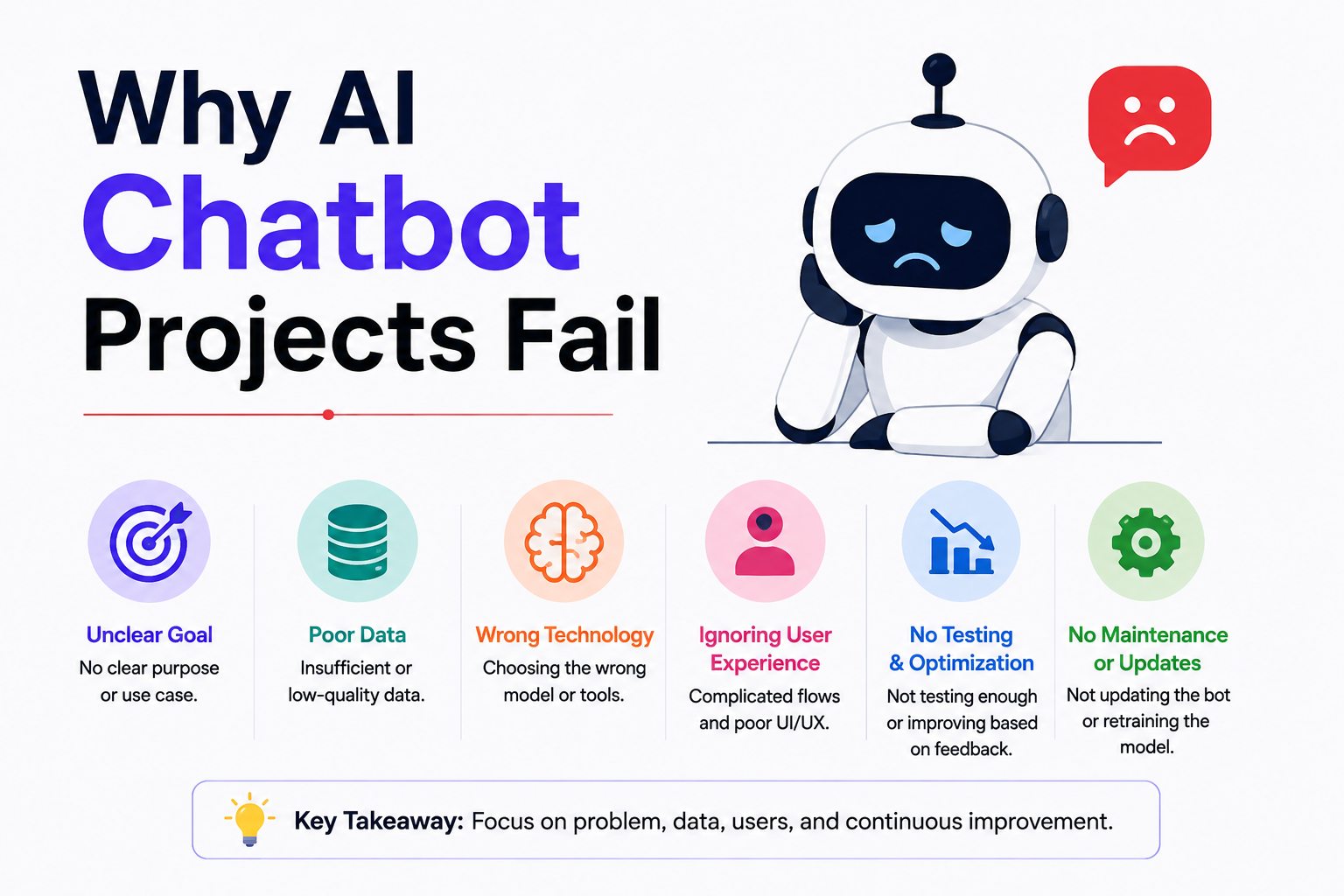
Most chatbot projects do not fail at the model. They fail at the parts that have nothing to do with AI:
Optimising for deflection instead of resolution. A bot rewarded for avoiding human handoff learns to trap users in loops. This destroys the customer satisfaction the project was meant to improve. Measure whether problems were actually solved.
Stale knowledge. A bot grounded in content nobody maintains slowly drifts into confidently wrong answers. Whoever owns the help centre now owns part of the chatbot — make this explicit from day one.
No automated tests. Without a regression suite, every change risks breaking behaviour somewhere else. You find out from customers instead of from CI.
Dead-end handoffs. When the bot cannot help, it must pass the user to a human with full conversation context attached. A handoff that forces the customer to repeat everything is worse than having no bot at all. Design the handoff experience with as much care as the chatbot conversation itself.
None of these are AI problems. They are product and engineering discipline problems — which is exactly why a structured build process matters more than which model you choose.
How Much Does It Cost to Build an AI Chatbot?
There is no single number. The cost structure has several components:
- Platform licensing or development cost
- LLM API costs (per token or per conversation)
- Telephony costs if voice is included
- Integration engineering (often the largest cost)
- Ongoing maintenance, monitoring, and tuning
A useful way to budget is per resolved conversation, compared to your current fully-loaded cost of a human handling the same contact. Most free tiers let you estimate this cheaply before committing.
Warning: be sceptical of any ROI projection that counts deflected conversations as resolved ones. They are not the same thing. A conversation deflected to a help article the user already read is not a resolution — it is a failed interaction that will become a support ticket anyway.
Quick Start Options
No-code builders: Tidio, Intercom, Drift, ManyChat — good for FAQ bots and simple lead capture without engineering involvement.
Low-code frameworks: Rasa, Botpress, Microsoft Bot Framework — good for production bots that take real actions with proper testing and version control.
From scratch: OpenAI API, Anthropic API, Google Vertex AI — good for custom builds where you want full control over every component.
For voice: Bland AI, Vapi, ElevenLabs Conversational AI — purpose-built for phone and voice-based chatbot deployments.
Start with the lowest-complexity approach that covers your use case. Migrate to more complex approaches only when you hit concrete limits.
Frequently Asked Questions
Can I build an AI chatbot for free?
Yes, to a point. No-code tools and free developer tiers let you build and test a real bot at no upfront cost. Costs appear at scale when conversation volume, LLM usage, or telephony for voice grows.
How long does it take to build an AI chatbot?
A simple FAQ bot can be live in a day on a no-code tool. A production assistant that integrates with your backend systems and is properly tested is a multi-week project. Integration work is almost always the long pole — not the conversational design.
Do I need to know how to code?
Not for a basic FAQ bot. No-code builders cover simple use cases without engineering. Once the bot needs to take real actions against your systems, or you need automated testing and version control, some engineering becomes necessary.
How do I stop my chatbot from making things up?
Use retrieval-augmented generation (RAG) to ground the model in your own content. When answers come from retrieved, source-controlled documents rather than open-ended generation, the model has far less room to hallucinate. Also use explicit skills with deterministic logic for any action the bot takes — do not rely on the model to decide whether to issue a refund.
What is the best chatbot platform in 2026?
It depends on your use case. For no-code FAQ bots: Tidio or Intercom. For production bots with real actions: Rasa or Botpress. For custom builds: OpenAI or Anthropic API directly. For voice: Bland AI or Vapi. Choose based on whether your bot answers questions or takes actions — that is the most important distinction.
Justin is a self-taught developer who builds and runs DeelCart himself — from the articles to the server it runs on. He manages his own Linux infrastructure and writes guides based on tools and workflows he actually uses day to day.