Claude Fable 5 vs GPT-5.6 Sol: Which AI Model is Better in 2026?
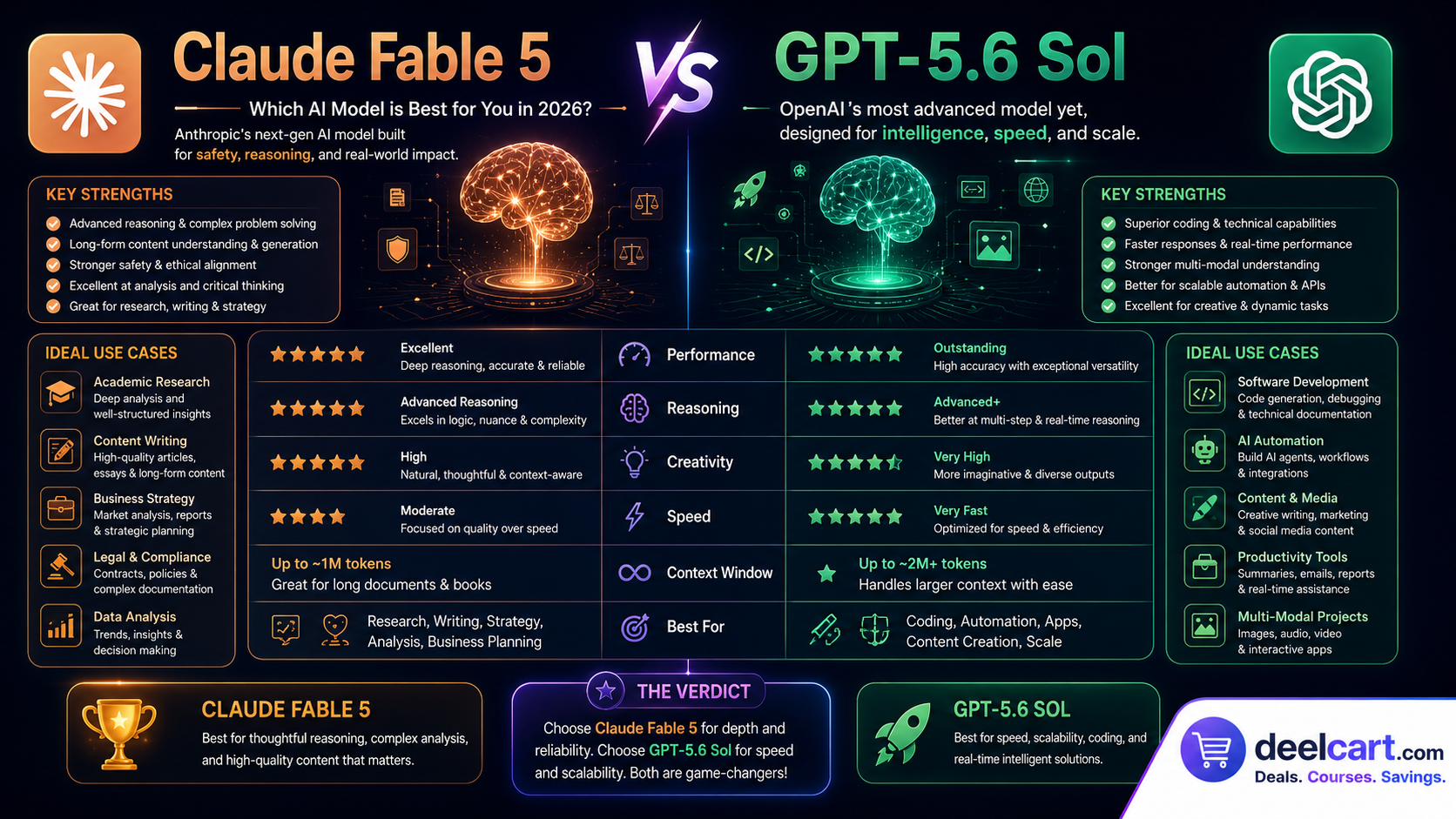
Both models were so capable they triggered US government export controls before their full public releases. Both ship with the most aggressive safety stacks their respective companies have ever deployed. And both are now available globally after those restrictions were lifted.
So which one is actually better — and which should you use? This guide compares Claude Fable 5 and GPT-5.6 Sol across every dimension that matters: benchmarks, pricing, context window, strengths, weaknesses, and real-world use cases.
Quick Overview
Claude Fable 5 is Anthropic's first Mythos-class model, released June 9, 2026. It sits above the Opus line in capability — the most powerful model Anthropic has ever made generally available. Anthropic describes it as built for "days-long, complex, and asynchronous tasks previous models couldn't sustain."
GPT-5.6 Sol is OpenAI's flagship model in the GPT-5.6 family, released for general availability on July 9, 2026. Sol is the top tier of a three-model family — Sol, Terra, and Luna — and OpenAI describes it as its "strongest model yet" and "best coding model yet."
Both models share remarkably similar specs on paper. The differences come out in real-world performance and use case fit.
Specs Comparison
| Feature | Claude Fable 5 | GPT-5.6 Sol |
|---|---|---|
| Developer | Anthropic | OpenAI |
| Released | June 9, 2026 | July 9, 2026 |
| Context Window | 1M tokens | 1.05M tokens |
| Max Output | 128K tokens | 128K tokens |
| Input Price | $10 / 1M tokens | $5 / 1M tokens |
| Output Price | $50 / 1M tokens | $30 / 1M tokens |
| Knowledge Cutoff | January 2026 | February 2026 |
| Thinking/Reasoning | Always on, adaptive | Ultra mode available |
| Safety Classifiers | Yes — reroutes to Opus 4.8 on restricted topics | Yes — most robust safety stack to date |
| Availability | Pro, Max, Team, Enterprise + API | ChatGPT Plus/Pro + API |
Pricing note: GPT-5.6 Sol is significantly cheaper than Fable 5 — half the input price and 40% cheaper on output. For high-volume API usage, this is a meaningful difference.
Benchmark Comparison
Both models compete at the very frontier of AI capability. Here is how they compare on the benchmarks that have been publicly reported:
Agentic Coding (Terminal-Bench 2.1):
- GPT-5.6 Sol: 88.8% (91.9% in Ultra mode)
- Claude Fable 5: benchmarks not officially published by Anthropic yet
- GPT-5.6 Sol: 80 (OpenAI claims 2.8 points above Fable 5)
- Claude Fable 5: approximately 77.2
- GPT-5.6 Sol: 53.6
- Claude Fable 5: approximately 40.5 (13.1 points below Sol)
- Claude Opus 5 (released July 24): 43.3%
- Claude Fable 5: 33.7%
What the benchmarks suggest: GPT-5.6 Sol appears to have a meaningful edge on coding-specific benchmarks. Whether that translates to better real-world coding performance depends heavily on the task.
Head-to-Head: Key Capabilities
Coding
This is GPT-5.6 Sol's strongest category. OpenAI describes Sol as its "best coding model yet" and the benchmark numbers support that claim — particularly for agentic coding tasks that involve running commands, navigating codebases, and completing multi-step implementations.
Sol also ships with an Ultra mode that uses multiple sub-agents working in parallel — giving it a further edge on complex, long-horizon coding tasks.
Fable 5 is still an exceptional coding model and competitive on most day-to-day coding tasks. But if coding is your primary use case, current evidence points to Sol as the stronger choice.
Edge: GPT-5.6 Sol
Reasoning and Knowledge Work
Both models excel at complex reasoning. Fable 5 uses always-on adaptive thinking — it decides for itself when and how deeply to reason, controlled through a simple effort parameter rather than manual thinking budgets.
Sol's reasoning similarly scales with task complexity, with Ultra mode pushing further for the hardest problems.
Based on early third-party testing, Fable 5 is described as feeling "big" in terms of how much it knows and how deeply it reasons through complex problems. Several independent testers report Fable 5 as stronger on nuanced knowledge work, research, and long-form reasoning tasks, even if Sol leads on structured coding benchmarks.
Edge: Tie — context dependent
Long-Context Tasks
Both models have effectively equivalent context windows — 1M tokens for Fable 5, 1.05M for Sol. Both support 128K output tokens.
At this scale, the difference is in how effectively each model uses that context. Fable 5 was specifically built for "days-long, complex, and asynchronous tasks" — suggesting Anthropic optimised it for long-horizon work. Early testing supports this, with Fable 5 performing well on tasks that require maintaining coherence and consistency across very long contexts.
Edge: Slight advantage to Fable 5 for very long-horizon tasks
Writing and Communication
Claude models have consistently been preferred for writing quality, nuance, and tone. Fable 5 continues this tradition — it produces prose that reads naturally, maintains consistent voice, and handles subtle instructions about style and tone better than most competing models.
For content creation, marketing copy, research reports, and any task where writing quality matters, Fable 5 is the stronger choice based on its lineage and early user reports.
Edge: Claude Fable 5
Safety and Reliability
Both models ship with the most aggressive safety stacks their respective companies have ever deployed — required given their capabilities in cybersecurity and other sensitive domains.
Fable 5's approach is notable: queries on restricted topics are automatically rerouted to Claude Opus 4.8 rather than refused outright, maintaining a useful response while keeping the most sensitive capabilities gated.
Sol similarly strengthened protections for sensitive cyber requests and high-risk activities, spending multiple weeks pressure-testing its safety system before release.
Edge: Tie — both represent new safety standards for their respective companies
Pricing and Cost Efficiency
Sol wins clearly here. At $5 input / $30 output per million tokens versus Fable 5's $10 / $50, Sol delivers frontier-level capability at significantly lower cost. For developers building production applications at scale, this difference compounds significantly.
Sol also reportedly achieves its benchmark-leading results with fewer tokens than competing models — meaning lower costs in practice even beyond the headline pricing difference.
Edge: GPT-5.6 Sol
Which Model Should You Use?
| Use Case | Best Choice |
|---|---|
| Complex coding and agentic development | GPT-5.6 Sol |
| Writing, research, and long-form content | Claude Fable 5 |
| Long-horizon agentic tasks | Claude Fable 5 |
| High-volume API production use | GPT-5.6 Sol (cheaper) |
| Scientific research and analysis | Tie |
| Cybersecurity work | GPT-5.6 Sol |
| Nuanced knowledge work and reasoning | Claude Fable 5 |
| Existing OpenAI/ChatGPT users | GPT-5.6 Sol |
| Existing Claude/Anthropic users | Claude Fable 5 |
The Verdict
Both models are genuinely frontier-class and represent a meaningful leap over everything that came before them in 2026. Neither is definitively "better" across the board — they have different strengths that suit different workflows.
Choose GPT-5.6 Sol if coding performance and API cost efficiency are your priorities. Sol leads on coding benchmarks, is significantly cheaper per token, and OpenAI's Ultra mode gives it an additional ceiling for the hardest tasks. It is also the natural choice if you are already embedded in the OpenAI ecosystem.
Choose Claude Fable 5 if you do long-horizon agentic work, writing quality matters, or you value Anthropic's approach to safety and nuanced reasoning. Fable 5's adaptive thinking, 1M context window optimised for sustained tasks, and strong writing quality make it the better tool for knowledge workers and researchers.
For most people — the honest answer is to try both. Both are available on their respective subscription plans, and the best model for your specific workflow will become obvious within a few sessions.
Frequently Asked Questions
Is Claude Fable 5 better than GPT-5.6 Sol?
It depends on the task. GPT-5.6 Sol leads on coding benchmarks and is cheaper. Claude Fable 5 is stronger for writing, long-horizon reasoning, and sustained agentic tasks. Neither is definitively better across all use cases.
How much does Claude Fable 5 cost?
Fable 5 is priced at $10 per million input tokens and $50 per million output tokens via the API, with a 90% discount on cached prompt tokens. It is included in Claude Pro, Max, Team, and Enterprise plans.
How much does GPT-5.6 Sol cost?
Sol is priced at $5 per million input tokens and $30 per million output tokens — making it significantly cheaper than Fable 5 at API scale.
Were these models banned by the US government?
Both models faced temporary US government export control restrictions shortly after release — Fable 5 from June 12 to June 30, and Sol during its limited preview period. Both are now fully available globally. This reflected government concern about the models' capabilities in sensitive areas like cybersecurity.
What is Claude Mythos 5?
Claude Mythos 5 is a version of Fable 5 without safety classifiers — same underlying capabilities but without the restrictions on sensitive topics. It is not publicly available and is only accessible to a small group of trusted organisations through Anthropic's Project Glasswing.
Is there a free version of these models?
GPT-5.6 Terra and Luna (the lower tiers) are available on ChatGPT's free and Plus plans. Claude Fable 5 requires a paid Claude plan. Neither flagship model is fully free, though both companies offer lower-tier models at no cost.
Justin is a self-taught developer who builds and runs DeelCart himself — from the articles to the server it runs on. He manages his own Linux infrastructure and writes guides based on tools and workflows he actually uses day to day.