Prompt Engineering Is Overrated — Here's What Actually Matters
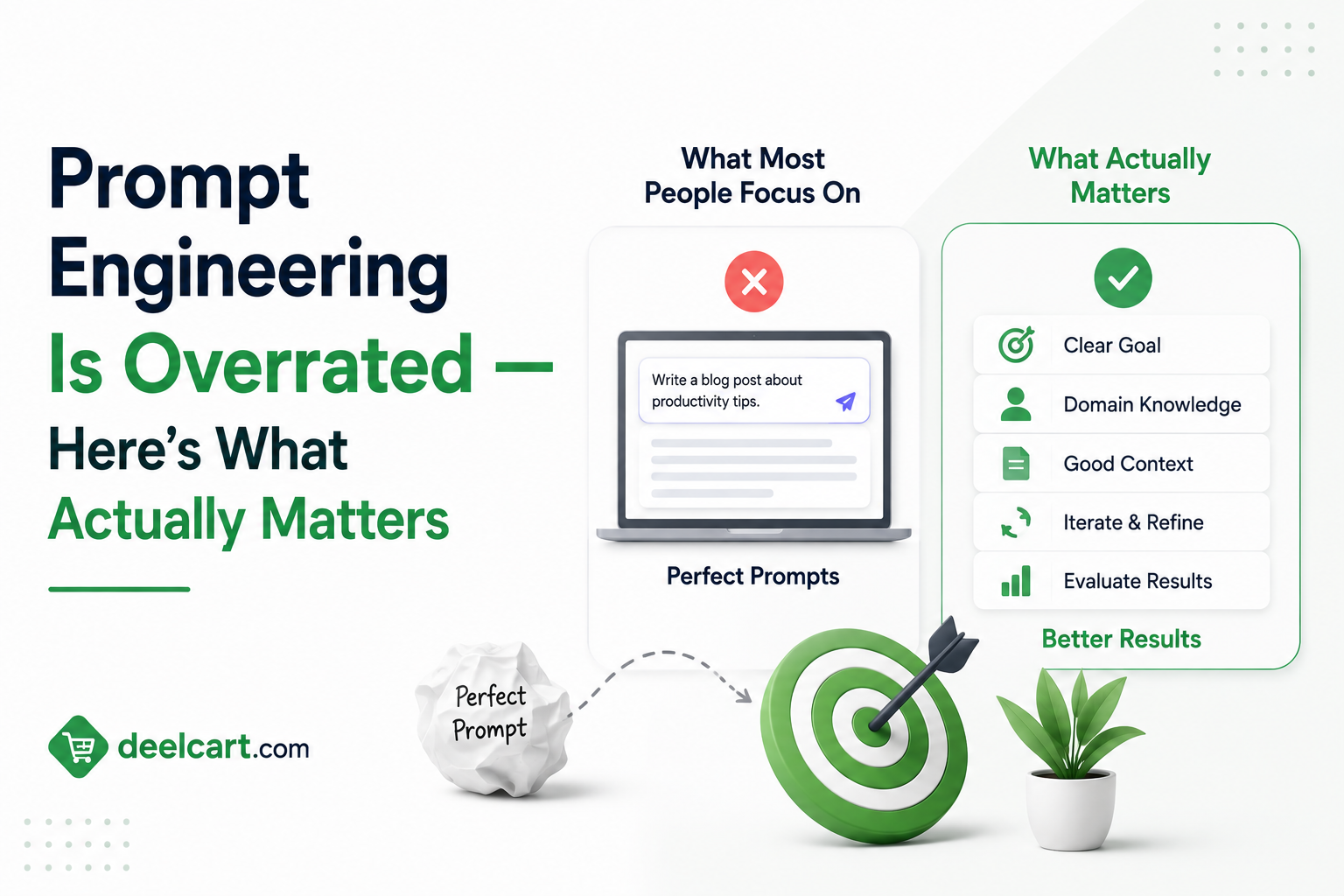
Most of it is noise.
Prompt engineering — the art of writing carefully structured prompts to get better outputs from AI — is real and useful. But it has been wildly overhyped. The gap between someone who knows prompt engineering frameworks and someone who does not is much smaller than the content marketing around the topic suggests.
The skills that actually separate people who get extraordinary value from AI from people who get mediocre results are different — and almost nobody talks about them.
This article covers what those skills actually are.
What Prompt Engineering Actually Is
Before arguing it is overrated, it is worth being precise about what prompt engineering means.
In its most legitimate form, prompt engineering refers to structured techniques for getting better outputs from language models — things like chain-of-thought prompting, few-shot examples, role prompting, and specifying output format explicitly.
These techniques work. Chain-of-thought prompting — asking the model to think step by step — genuinely improves reasoning quality on complex problems. Few-shot examples — showing the model two or three examples of what you want before asking for the real thing — genuinely improves output consistency.
The problem is not that these techniques are wrong. The problem is the conclusion people draw from them — that learning a set of prompt patterns is the main skill required to work effectively with AI. It is not. It is maybe the fifth most important skill.
Why Prompt Engineering Is Overrated
The Models Have Gotten Too Good for It to Matter Much
In 2023, the difference between a well-engineered prompt and a poorly written one was enormous. Early GPT-4 required careful coaxing to produce reliable output. The right prompt structure could double or triple output quality.
In 2026, frontier models are dramatically more capable and dramatically more robust to poorly written prompts. Claude Fable 5 and GPT-5.6 Sol understand what you mean even when your phrasing is imprecise. They infer context. They ask clarifying questions when they are confused. They produce good output from mediocre prompts far more reliably than models did two years ago.
The diminishing returns on prompt engineering are real. A prompt that would have required careful structuring in 2023 can now be written conversationally and produces comparable results.
Most Prompt Engineering Content Teaches Tricks, Not Thinking
A large proportion of prompt engineering content teaches you to append phrases to your prompts — "think step by step", "you are an expert in", "respond only in JSON format". These are useful to know. They take five minutes to learn. They do not require a course, a certification, or a dedicated practice.
The content that packages these simple observations into elaborate frameworks and sells them as a transformative skill is mostly marketing. You do not need to know the difference between a zero-shot prompt and a three-shot prompt to use AI effectively in your daily work.
The Bottleneck Is Rarely the Prompt
When someone gets a bad output from an AI model the instinct is to blame the prompt and try to engineer a better one. Often the real problem is elsewhere:
- They are using AI for a task it is genuinely bad at
- They are not verifying the output critically
- They are not giving the model enough context about the actual problem
- They are not iterating — they treat the first output as final
- They are using the wrong model for the task
What Actually Matters
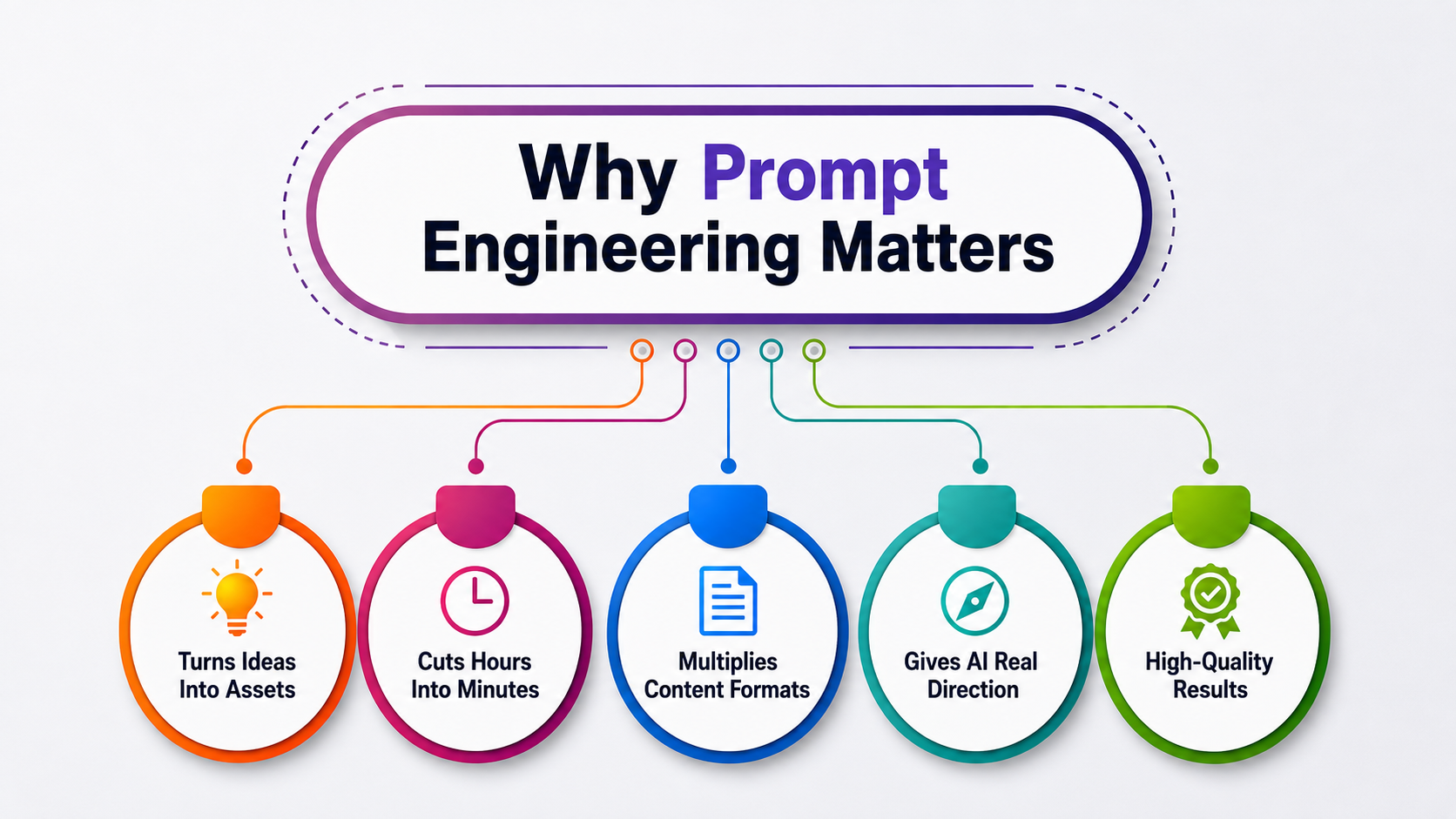
1. Knowing What AI Is Actually Good At
The highest-leverage skill when working with AI is knowing which tasks to use it for and which tasks to avoid.
AI is excellent at certain categories of work — generating first drafts, explaining concepts at multiple levels of detail, summarising large amounts of information, writing and debugging code, brainstorming a large number of ideas quickly, reformatting and transforming structured data, translating between languages and styles.
AI is genuinely bad at other categories — current factual information without search access, precise arithmetic, tasks requiring consistent long-term memory across sessions, highly specialised domain knowledge at the frontier, tasks requiring verified sources.
People who get the most value from AI have developed an accurate mental model of these strengths and weaknesses. They reach for AI instantly when a task falls in the first category. They do not waste time trying to use AI for tasks in the second category — or they use it as a starting point while knowing they need to verify heavily.
This sounds obvious but it is not. Most people either over-rely on AI for everything and are frequently disappointed, or under-rely on it out of distrust and miss significant productivity gains. Calibrated understanding of AI capability is the foundational skill.
2. Context, Not Prompts
The single biggest improvement most people can make to their AI outputs has nothing to do with prompt structure. It is providing better context.
AI models are generalists. When you ask a question without context, the model generates an answer that fits the most common version of that situation. It does not know your industry, your audience, your constraints, your existing work, or what you have already tried.
The more relevant context you provide — who you are, what you are trying to achieve, what constraints you are working within, what you have already done, what a good answer looks like for your specific situation — the better the output.
Compare these two approaches:
Approach A: "Write me an email to my team about the project delay."
Approach B: "I am the engineering lead at a fintech startup. We are three weeks behind on a payment processing feature because a third-party API we depend on changed their authentication method with no notice. I need to write an email to my cross-functional team — product, design, and customer success — explaining the delay, the cause, the new timeline, and what each team needs to do differently in the next two weeks. The tone should be direct but not panicked. Here is my first draft: [draft]."
Approach B has nothing to do with prompt engineering frameworks. It just has more context. The output will be dramatically more useful.
The practical skill here is learning to front-load relevant context before asking your question. This feels slower at first but produces better outputs consistently.
3. Critical Evaluation of Outputs
AI models are confidently wrong with disturbing frequency. They hallucinate facts, cite sources that do not exist, make arithmetic errors, misapply domain knowledge, and produce code that looks correct but has subtle bugs.
The most dangerous AI user is someone who trusts outputs uncritically. The most effective AI user has a calibrated level of scepticism — they know which categories of AI output to trust and which to verify.
For factual claims — especially specific data, statistics, quotes, and citations — assume the AI might be wrong and verify independently. For code — run it and test it rather than assuming it works. For domain-specific advice — check against your own expertise or consult a specialist.
This is not a reason to distrust AI entirely. It is a reason to treat AI output the way you would treat output from a brilliant but sometimes overconfident junior colleague — worth engaging with, always worth reviewing, never blindly trusted.
Developing this scepticism is not about learning prompt tricks. It is about building good judgment through experience with what AI gets wrong in your specific domain.
4. Iteration and Conversation
Most people treat an AI interaction as a single exchange — they write a prompt, read the output, and either use it or give up. The people who get the most value from AI treat it as a conversation.
If the first output is not quite right, they push back — "this is too formal, make it more conversational", "the second paragraph is off, here is what I actually meant", "this code works but it is inefficient, can you rewrite it using a hashmap instead?"
They also build on good outputs — "now write a second version that takes a more pessimistic view of the timeline", "expand the third section with two more examples", "now convert this from Python to TypeScript."
This iteration costs almost nothing — AI is essentially free per exchange for most use cases. The bottleneck is not token cost, it is the willingness to iterate. Treating the first output as a draft rather than a finished product consistently produces better results.
The conversational approach also means being willing to tell the AI when it is wrong and why. Frontier models in 2026 respond well to pushback with specific reasons — "this is incorrect because X" produces a better corrected output than "that is wrong, try again."
5. Knowing When Not to Use AI
This is the skill nobody talks about in prompt engineering content — because it does not fit the narrative that more AI is always better.
There are categories of tasks where using AI actively makes you worse:
Learning and skill development. If you use AI to write every email, every document, and every piece of code, you stop practising those skills. Over time your own capability atrophies while you become more dependent on AI for tasks you used to handle fluently. For skills you want to develop and retain, do the work yourself. Use AI to learn, not to replace doing.
Tasks requiring genuine original thought. AI is excellent at remixing and synthesising existing patterns. It is less good at generating ideas that are genuinely novel. If your job requires real intellectual originality — scientific research, genuine creative work, novel strategic thinking — AI can support the work but should not drive it. Over-relying on AI for these tasks produces ideas that feel fresh but are often recombinations of patterns in the training data.
High-stakes communications where voice matters. An AI-written email sounds like an AI-written email to people who interact with you regularly. For high-stakes relationships — important clients, senior stakeholders, close colleagues — writing in your own voice builds trust in a way that polished AI output does not.
Knowing when to put AI aside is as important as knowing when to reach for it.
6. Domain Knowledge Is Still the Leverage Point
Here is the uncomfortable truth about AI productivity that prompt engineering hype obscures: the people who get the most value from AI are almost always domain experts, not prompt experts.
A software engineer with ten years of experience gets dramatically more value from AI coding tools than a beginner with the same tools — because they can evaluate the output, spot the errors, direct the iteration, and understand when the AI is confidently producing something subtly wrong.
A marketing director gets dramatically more value from AI writing tools than a first-year intern — because they know what good marketing copy sounds like, what their audience responds to, and when the AI is producing generic content that sounds professional but will not perform.
Domain expertise is the multiplier. AI amplifies what you bring to the table. If you bring expertise, AI amplifies it. If you bring shallowness, AI produces better-sounding shallowness.
This means the highest-return investment you can make for AI productivity is not learning more prompt techniques — it is deepening your domain expertise. The better you understand your field, the more effectively you can direct AI, evaluate its outputs, and catch its errors.
What Is Worth Learning
None of this means there is nothing worth learning about working with AI. There is. It just is not what most prompt engineering content focuses on.
Worth learning:
- What the major models are good and bad at — and how this changes as models improve
- How to provide context effectively — what information the model needs to produce a useful output for your specific situation
- How to iterate productively — how to give useful feedback that produces better second and third outputs
- Model-specific quirks — Claude tends toward verbose outputs by default, GPT-4o is better at following strict output format instructions, Gemini's web search integration makes it better for current information tasks
- When to use which tool — not all AI tools are equivalent for all tasks
- Basic prompt structures for specific use cases — few-shot examples for classification tasks, chain-of-thought for reasoning tasks, explicit format specification for structured outputs
- Elaborate prompt engineering frameworks with acronyms
- Prompt engineering certifications
- Prompt libraries of magic phrases
- Optimising prompts for models that will be superseded in six months
The Honest Summary
Prompt engineering is a real skill with genuine value. It has also been vastly oversold as a transformative capability that separates AI power users from everyone else. The reality is more mundane — the basics are easy to learn, the advanced techniques have diminishing returns as models improve, and the skills that actually produce consistently better AI outputs are about understanding, context, iteration, and critical thinking rather than prompt structure.
The people getting the most value from AI in 2026 are not the ones who know the most prompt engineering frameworks. They are the ones who have an accurate understanding of what AI can and cannot do, who provide rich context, who iterate with useful feedback, who evaluate outputs critically, and who bring deep domain knowledge to every AI interaction.
Those skills are worth developing. The rest is mostly marketing.
Frequently Asked Questions
Is prompt engineering a real job in 2026?
It exists but the role has evolved significantly. Most organisations that originally hired dedicated prompt engineers have either eliminated the role or merged it with broader AI engineering or data science functions. As models have become better at understanding natural language, the value of dedicated prompt expertise has declined. What remains valuable is AI systems design — architecting how AI fits into workflows, evaluating models for specific use cases, and building AI-powered products. That is a real and growing job. Prompt engineering as a standalone skill is not.
Should I take a prompt engineering course?
The basic techniques are worth knowing and can be learned in a few hours from free resources. A short free course or a well-written article covers everything you need for practical everyday use. A paid multi-week certification course is almost certainly not worth the investment — particularly because the techniques it teaches will continue to matter less as models improve.
Does providing more context always help?
Generally yes, but there is a practical limit. Dumping ten pages of background information into a prompt does not always produce better output than three well-chosen paragraphs. The skill is providing the right context — the information that is actually relevant to producing a good output for your specific situation — rather than maximum context.
Are some people genuinely better at using AI than others?
Yes — but not primarily because of prompt technique. People who are better at using AI tend to have more accurate models of what AI is good at, clearer communication skills generally, more domain expertise to evaluate and direct outputs, and more willingness to iterate. These are general intellectual skills that transfer to AI use rather than AI-specific skills.
Will AI get good enough that prompt engineering becomes completely irrelevant?
Increasingly yes for most everyday use cases. The trend is toward models that require less careful prompting — they ask clarifying questions, infer context, and produce useful output from natural language requests that would have produced poor results from earlier models. For highly specialised use cases — production AI systems, complex multi-step pipelines, fine-tuning and evaluation — technical skills around AI systems remain valuable. For everyday productivity use, the gap between good and bad prompting is narrowing toward zero.
Justin is a self-taught developer who builds and runs DeelCart himself — from the articles to the server it runs on. He manages his own Linux infrastructure and writes guides based on tools and workflows he actually uses day to day.