How I'd Learn Machine Learning in 2026 (Complete Roadmap)
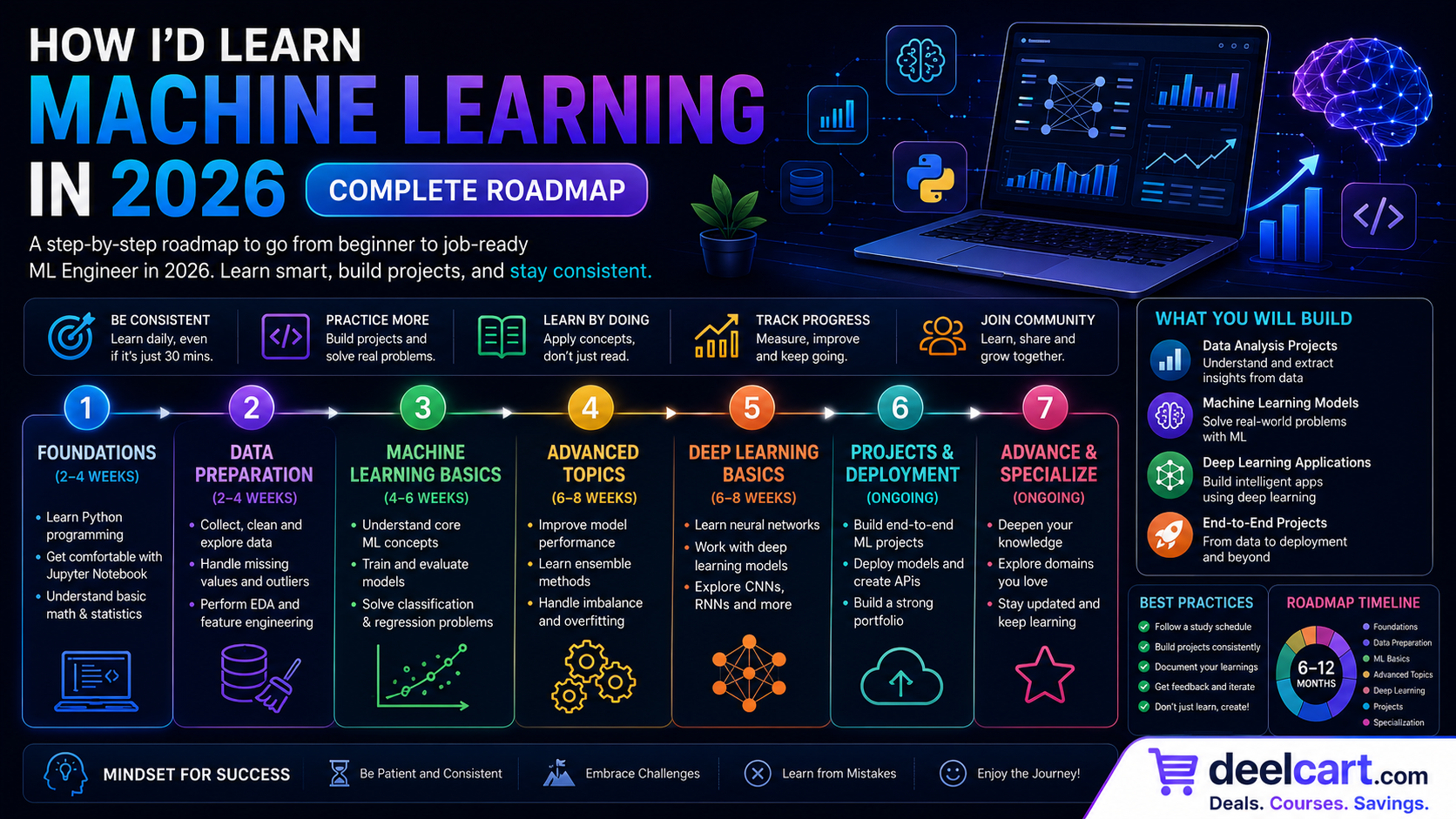
Most beginners make the same mistakes — they spend months on maths theory before writing a single line of code, they jump between tutorials without finishing anything, and they never build real projects that force them to actually understand what they are doing.
This guide is the roadmap I would follow if I were starting today — practical, structured, and honest about what actually matters versus what sounds impressive but does not help you build real skills.
Who This Guide Is For
This roadmap is designed for:
- Complete beginners with no prior machine learning experience
- Developers who know how to code but have never worked with ML
- People who have tried to learn ML before but got lost or gave up
- Anyone who wants to build real ML projects, not just follow tutorials
The Honest Truth About Learning Machine Learning in 2026
Before the roadmap, a few things worth knowing:
Machine learning is more accessible than ever. Libraries like scikit-learn, PyTorch, and Hugging Face have abstracted away enormous amounts of complexity. You can build a working image classifier in 20 lines of Python today. The barrier to entry has never been lower.
But fundamentals still matter. AI tools can generate ML code for you instantly in 2026. What they cannot do is tell you why a model is underperforming, which algorithm to choose for your problem, or how to debug a training run that is producing nonsense. That requires genuine understanding.
Projects beat tutorials. You can watch 200 hours of ML tutorials and still not be able to build anything. The only way to actually learn is to build projects that have problems you have to solve yourself.
It takes longer than the internet suggests. Most "learn ML in 30 days" claims are nonsense. A realistic timeline to genuine ML competence — where you can build and deploy real models — is 6 to 12 months of consistent effort.
With that said, here is exactly how I would spend those months.
Phase 1 — Build Your Python Foundation (Weeks 1 to 4)
Machine learning is done in Python. Before touching any ML library, you need to be comfortable with Python — not expert level, but solid enough that the language is not the bottleneck when you are trying to learn ML concepts.
What to learn:
- Variables, data types, lists, dictionaries, tuples
- Functions, loops, conditional logic
- List comprehensions
- File handling — reading and writing CSV and JSON files
- Basic object-oriented programming — classes and methods
- Installing and using libraries with pip
What to build: A simple data analysis script. Download a CSV dataset — crime statistics, weather data, sports results — and write Python code that reads it, filters it, calculates averages, and prints a summary. This forces you to use the core skills before moving on.
Free resources:
- Free Python courses on FreeWebCart — search for beginner Python courses with 100% OFF coupons
- Python's official documentation at docs.python.org
Phase 2 — Learn the Core Data Science Libraries (Weeks 5 to 8)
Machine learning in Python is built on three foundational libraries — NumPy, Pandas, and Matplotlib. Every ML library you use later is built on top of these. Skipping this phase is the single most common mistake beginners make, and it causes confusion later when they do not understand what their data looks like or how to prepare it.
NumPy
NumPy provides fast numerical computing in Python using arrays. Almost all ML data is represented as NumPy arrays under the hood.
What to learn:
- Creating and manipulating arrays
- Array indexing and slicing
- Mathematical operations on arrays
- Broadcasting — how NumPy handles operations on differently shaped arrays
- Random number generation
Pandas
Pandas is the primary tool for loading, cleaning, and exploring structured data. Before you can train any ML model, your data needs to be clean and properly formatted — Pandas is how you do that.
What to learn:
- Loading CSV, Excel, and JSON files into DataFrames
- Selecting and filtering rows and columns
- Handling missing values
- Grouping and aggregating data
- Merging and joining datasets
- Basic data cleaning — removing duplicates, fixing data types
Matplotlib and Seaborn
Visualising data before training a model is not optional — it is how you understand what your data actually looks like, spot problems, and make better modelling decisions.
What to learn:
- Line plots, bar charts, scatter plots, histograms
- Customising plot titles, labels, and colours
- Seaborn for statistical visualisations — heatmaps, pair plots, distribution plots
Phase 3 — Learn Machine Learning Fundamentals with Scikit-learn (Weeks 9 to 16)
This is where machine learning actually starts. Scikit-learn is the standard Python library for classical machine learning — the algorithms that have been proven to work reliably across a huge range of problems.
Do not jump to neural networks yet. The biggest mistake beginners make is going straight to deep learning without understanding classical ML. Classical algorithms are faster, more interpretable, and often more appropriate for real-world problems than deep learning.
Start with the Core Concepts
Before learning any algorithm, understand these fundamental concepts:
Supervised vs unsupervised learning:
- Supervised: you train on labelled data — inputs with known correct outputs
- Unsupervised: you find patterns in unlabelled data
- Classification: predicting a category — spam or not spam, cat or dog
- Regression: predicting a number — house price, temperature, sales volume
- You train your model on one portion of your data and test it on data it has never seen
- This is how you measure whether your model actually learned something or just memorised the training data
- Overfitting: model performs great on training data but poorly on new data — it memorised rather than learned
- Underfitting: model performs poorly even on training data — it has not learned enough
Algorithms to Learn
Learn these algorithms in order, understanding what problem each one solves and when to use it:
1. Linear Regression Predict a continuous number from input features. Start here — it is the simplest algorithm and introduces the core concepts of model training and evaluation.
2. Logistic Regression Classify inputs into two or more categories. Despite the name, it is a classification algorithm. Understand it deeply — it is the foundation of neural networks.
3. Decision Trees Learn a tree of if-then rules from data. Highly interpretable and works on both classification and regression problems.
4. Random Forests An ensemble of decision trees that produces better predictions than any individual tree. One of the most reliably effective algorithms for structured data.
5. Gradient Boosting (XGBoost, LightGBM) The most powerful algorithms for structured tabular data. XGBoost wins more Kaggle competitions than any other algorithm. Learn it well.
6. K-Nearest Neighbours Classify new data points based on the most similar examples in your training set. Simple, intuitive, and a great teaching algorithm.
7. Support Vector Machines Powerful classification algorithm that finds the optimal boundary between classes. Useful for smaller datasets and high-dimensional data.
8. K-Means Clustering Group unlabelled data into clusters based on similarity. Your introduction to unsupervised learning.
Model Evaluation
Learning algorithms is only half the battle. Equally important is knowing how to measure whether your model is actually good:
For classification: Accuracy, precision, recall, F1 score, ROC-AUC curve, confusion matrix For regression: Mean absolute error, mean squared error, R-squared
Understand not just what these metrics are but when each one matters. Accuracy is misleading on imbalanced datasets. Precision and recall matter differently depending on your problem domain.
Feature Engineering
In real ML projects, the quality of your features — the inputs to your model — matters more than the algorithm you choose. Learn:
- Handling categorical variables — one-hot encoding, label encoding
- Scaling numerical features — standardisation, normalisation
- Handling missing data — imputation strategies
- Creating new features from existing ones — date features, interaction terms
- Feature selection — identifying which features actually help your model
1. Classification project: Predict whether a patient has diabetes using the Pima Indians Diabetes dataset 2. Regression project: Predict house prices using the Boston Housing or California Housing dataset 3. Clustering project: Segment customers using the Mall Customer Segmentation dataset
For each project: load data, explore it, clean it, engineer features, train multiple algorithms, evaluate and compare them, and write up your findings.
Phase 4 — Learn Deep Learning with PyTorch (Weeks 17 to 28)
Once you are comfortable with classical ML, deep learning becomes much easier to understand because you already know the foundational concepts. Neural networks are an extension of what you already know — not a completely different discipline.
Why PyTorch Over TensorFlow
In 2026, PyTorch has become the dominant deep learning framework. It is the standard in academic research and has been widely adopted in industry. If you are starting today, learn PyTorch — TensorFlow knowledge transfers easily later if needed.
Neural Network Fundamentals
Start by understanding what neural networks actually are before writing any PyTorch code:
What to understand:
- Neurons, layers, and activations — how information flows through a network
- Forward pass — how a neural network makes a prediction
- Loss functions — how we measure how wrong a prediction is
- Backpropagation — how a network learns from its mistakes
- Gradient descent — the optimisation algorithm that updates weights
- Learning rate — how large each update step is
PyTorch Fundamentals
What to learn:
- Tensors — PyTorch's equivalent of NumPy arrays
- Autograd — PyTorch's automatic differentiation system
- Building neural networks with
nn.Module - Training loops — forward pass, loss calculation, backward pass, optimiser step
- DataLoaders — efficiently loading and batching training data
- Saving and loading models
Computer Vision with CNNs
Convolutional Neural Networks are the foundation of computer vision. Learn them by building an image classifier:
What to learn:
- Convolution operations and why they work for images
- Pooling layers and their role
- CNN architecture — convolutional blocks, fully connected layers
- Transfer learning — fine-tuning pre-trained models like ResNet and EfficientNet
- Data augmentation — artificially expanding your training dataset
Natural Language Processing with Transformers
In 2026, transformers have become the foundation of almost all NLP and much of modern AI. Understanding them is essential.
What to learn:
- Recurrent Neural Networks — the architecture transformers replaced
- Attention mechanism — the key innovation behind transformers
- Transformer architecture — encoder, decoder, self-attention, positional encoding
- BERT and GPT model families — how they differ and when to use each
- Hugging Face Transformers library — the standard tool for working with pre-trained language models
- Fine-tuning pre-trained models on custom datasets
Phase 5 — Build Real Projects and Get Experience (Weeks 29 onwards)
Everything up to this point has been learning. Phase 5 is where you become someone who actually knows machine learning — by building real projects that have real problems.
The Right Way to Build ML Projects
Do not build tutorial projects. Build projects where you have to make decisions without being told the answer.
Find your own dataset: Kaggle, UCI Machine Learning Repository, Hugging Face Datasets, and government open data portals all have thousands of real datasets. Pick something you find genuinely interesting.
Define a real problem: Do not just train a model on a dataset — define a specific question you want to answer and a metric you want to optimise.
Document your process: Write up what you tried, what worked, what did not, and why. This is what goes in your portfolio.
Deploy your model: A model that only runs on your laptop is not a product. Learn to deploy models as APIs using FastAPI or Flask, and host them on a cloud platform.
Project Ideas by Difficulty
Beginner projects:
- Movie recommendation system using collaborative filtering
- Email spam classifier using text features
- Stock price prediction using historical data (note: predicting stock prices is hard and this is an exercise in ML process, not a trading strategy)
- Real estate price prediction with feature engineering and model stacking
- Medical image classification using transfer learning
- Customer churn prediction with class imbalance handling
- Named entity recognition on a custom text dataset
- Fine-tune a large language model on a domain-specific dataset
- Build an end-to-end ML pipeline with automated retraining
- Object detection system using YOLO or DETR
- Reinforcement learning agent that plays a simple game
Compete on Kaggle
Kaggle competitions are the fastest way to improve your ML skills. You work on real datasets with clear evaluation metrics and can see exactly where you rank against thousands of other practitioners.
Start with getting-started competitions — the Titanic survival prediction and House Price prediction competitions are the traditional starting points. Then move to active competitions where you compete in real time.
The process of reading top notebooks, understanding why the top-ranked solutions work, and iterating on your own approach teaches more practical ML than almost any course.
Build in Public
Write about what you are building. Post on LinkedIn, start a blog, share your Jupyter notebooks on GitHub. This serves two purposes: it solidifies your understanding (you cannot write clearly about something you do not understand) and it builds a portfolio that demonstrates your skills to employers.
Phase 6 — MLOps and Production ML (Optional but Valuable)
If your goal is a professional ML role, understanding how models go from a Jupyter notebook to a production system is increasingly important.
What to learn:
- Experiment tracking: MLflow or Weights and Biases for tracking model experiments
- Model versioning: Saving, versioning, and managing trained models
- Model serving: Deploying models as REST APIs with FastAPI
- Containerisation: Packaging models in Docker containers for reproducible deployment
- CI/CD for ML: Automating model training, testing, and deployment pipelines
- Monitoring: Detecting model drift and performance degradation in production
- Feature stores: Managing and serving features consistently across training and inference
The Complete Learning Roadmap at a Glance
| Phase | Timeline | Focus |
|---|---|---|
| Phase 1 — Python | Weeks 1–4 | Core Python programming skills |
| Phase 2 — Data Libraries | Weeks 5–8 | NumPy, Pandas, Matplotlib |
| Phase 3 — Classical ML | Weeks 9–16 | Scikit-learn, algorithms, evaluation |
| Phase 4 — Deep Learning | Weeks 17–28 | PyTorch, CNNs, Transformers |
| Phase 5 — Real Projects | Weeks 29+ | Kaggle, portfolio, deployment |
| Phase 6 — MLOps | Ongoing | Production ML, deployment, monitoring |
How Much Maths Do You Actually Need?
This is the most common question from beginners and the most misunderstood topic in ML education.
The short answer: less than most people tell you, but more than zero.
You do not need:
- University-level calculus derivations from scratch
- Deep linear algebra proofs
- Advanced statistics theory
- Basic calculus — understanding what a derivative is and what it represents intuitively
- Linear algebra basics — vectors, matrices, matrix multiplication, dot products
- Probability and statistics — mean, variance, distributions, Bayes' theorem
- Intuitive understanding of gradient descent — you do not need to derive it, but you need to understand what it is doing
Fast.ai's courses famously teach ML from the top down — getting you building working models first, then explaining the underlying concepts. This approach is highly effective and worth considering as an alternative to the bottom-up roadmap above.
Frequently Asked Questions
Do I need a GPU to learn machine learning?
Not to get started. Classical ML (Phase 3) runs fine on any computer. For deep learning (Phase 4), you can use Google Colab or Kaggle Notebooks — both provide free GPU access in the cloud. You do not need to buy a GPU until you are training large models regularly.
Should I learn TensorFlow or PyTorch?
PyTorch in 2026. It has become the dominant framework in both research and industry. TensorFlow is still used in production systems and some enterprise environments, but new practitioners should start with PyTorch.
Can I get an ML job without a degree?
Yes, but it is harder. A strong portfolio of real projects, Kaggle competition results, and contributions to open source ML projects can compensate for a lack of formal education. Companies increasingly hire based on demonstrated skill. A degree in maths, statistics, or computer science helps but is not a hard requirement at most companies.
How much Python do I need to know before starting ML?
You need to be comfortable with the basics — functions, loops, lists, dictionaries, and basic file handling. You do not need to be an expert Python developer. Most ML learners improve their Python significantly as they work through ML projects.
Is machine learning still worth learning in 2026 with AI tools everywhere?
Yes — more than ever. AI tools can generate ML code but they cannot replace the judgment, debugging skills, and domain knowledge needed to build ML systems that actually work reliably in production. The practitioners who understand ML deeply and use AI tools effectively are the most valuable in the market.
Justin is a self-taught developer who builds and runs DeelCart himself — from the articles to the server it runs on. He manages his own Linux infrastructure and writes guides based on tools and workflows he actually uses day to day.