Serverless vs Traditional Hosting: A Real-World Cost Breakdown
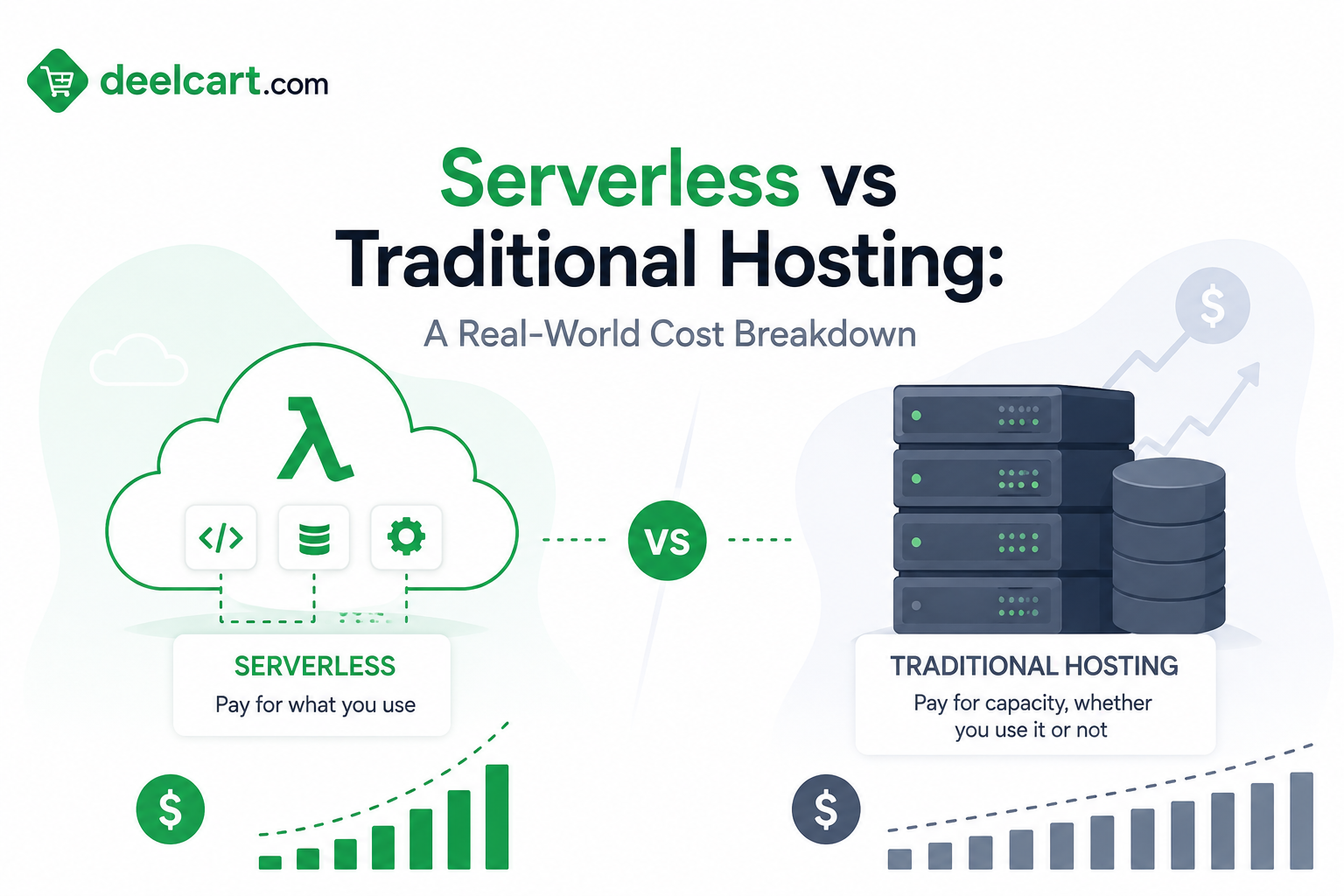
The reality is more complicated. Serverless is cheaper in some situations and dramatically more expensive in others. The difference depends on your traffic patterns, your workload characteristics, and the details of how you architect and implement your application.
This guide breaks down the real costs of serverless versus traditional hosting with actual numbers — so you can make an informed decision rather than one based on marketing.
What We Are Actually Comparing
Serverless hosting in this context means Function-as-a-Service platforms — AWS Lambda, Google Cloud Functions, Azure Functions, and Vercel Functions. You deploy code, the platform executes it in response to events, and you pay per invocation and per duration of execution. No server runs continuously. When there is no traffic, there is no cost.
Traditional hosting means running a server continuously — whether that is a VPS on DigitalOcean or Linode, an EC2 instance on AWS, a dedicated server, or a managed hosting platform like Heroku or Railway. The server runs 24 hours a day and you pay for it regardless of whether it is handling requests or sitting idle.
The comparison is not serverless versus physical servers. It is serverless versus continuously running compute — which includes cloud VMs, managed containers, and platform-as-a-service products.
The Core Economics of Each Approach
How Serverless Pricing Works
AWS Lambda — the most widely used serverless platform — charges on two dimensions. The first is invocations — the number of times your function is called. The first one million invocations per month are free. Beyond that, the price is $0.20 per million invocations.
The second dimension is duration — how long your function runs multiplied by how much memory it is configured with. Duration is measured in GB-seconds — gigabytes of memory multiplied by seconds of execution time. The price is $0.0000166667 per GB-second.
As a concrete example: a function configured with 512MB of memory that runs for 200 milliseconds uses 0.5 GB × 0.2 seconds = 0.1 GB-seconds per invocation.
Google Cloud Functions and Azure Functions use similar pricing models. Vercel Functions are priced differently — by compute time and bandwidth — but the fundamental structure is the same: pay per execution, pay nothing when idle.
How Traditional Hosting Pricing Works
A DigitalOcean Droplet — one of the most widely used VPS options — costs a flat monthly fee regardless of usage:
- 1 vCPU, 1GB RAM — $6 per month
- 1 vCPU, 2GB RAM — $12 per month
- 2 vCPU, 4GB RAM — $24 per month
- 4 vCPU, 8GB RAM — $48 per month
A Heroku Basic Dyno — one of the simplest managed options — costs $7 per month for a continuously running process.
The key characteristic of traditional hosting is that the cost is fixed and continuous — it runs whether you use it or not.
Real-World Scenario 1 — Low Traffic API
Setup: A simple REST API for a personal project or small business. Handles requests for user data, sends occasional emails, processes form submissions.
Traffic profile: 50,000 requests per month. Average function duration of 100 milliseconds. 256MB memory allocation.
Serverless cost calculation (AWS Lambda):
Invocations cost: 50,000 requests — well within the free tier of 1 million invocations. Cost: $0.
Duration cost: 50,000 requests × 0.1 seconds × 0.25 GB = 1,250 GB-seconds. The free tier includes 400,000 GB-seconds per month. Cost: $0.
Total serverless cost: $0 per month — within the permanent free tier.
Traditional hosting cost:
The smallest viable server — a $6/month DigitalOcean Droplet or a $7.59/month EC2 t3.micro — runs continuously regardless of 50,000 requests or zero.
Total traditional hosting cost: $6 to $8 per month.
Verdict: Serverless wins decisively for low traffic workloads. The free tiers of all major serverless platforms comfortably cover small personal projects and low-traffic business applications at zero cost. You would need to pay for traditional hosting that handles the same workload at no benefit.
Real-World Scenario 2 — Medium Traffic SaaS API
Setup: A SaaS application API serving a growing user base. Handles authentication, data retrieval, and business logic operations.
Traffic profile: 10 million requests per month. Average function duration of 150 milliseconds. 512MB memory allocation.
Serverless cost calculation (AWS Lambda):
Invocations cost: 10 million requests − 1 million free = 9 million billable invocations × $0.20 per million = $1.80.
Duration cost: 10 million requests × 0.15 seconds × 0.5 GB = 750,000 GB-seconds − 400,000 free = 350,000 billable GB-seconds × $0.0000166667 = $5.83.
Total serverless cost: approximately $7.63 per month.
Traditional hosting cost:
10 million requests per month is approximately 3.9 requests per second average — easily handled by a small server. A DigitalOcean Droplet with 2 vCPU and 4GB RAM at $24 per month handles this comfortably with significant headroom.
A t3.small EC2 instance — 2 vCPU, 2GB RAM — costs approximately $15.18 per month on-demand or $9.13 on a one-year reserved instance.
Total traditional hosting cost: $15 to $24 per month.
Verdict: Serverless wins again at this traffic level — significantly cheaper than equivalent traditional hosting with similar or better reliability and zero infrastructure management.
Real-World Scenario 3 — High Traffic Application
Setup: A high-traffic web application with consistent steady traffic throughout the day.
Traffic profile: 200 million requests per month. Average function duration of 200 milliseconds. 512MB memory allocation.
Serverless cost calculation (AWS Lambda):
Invocations cost: 200 million − 1 million free = 199 million billable × $0.20 per million = $39.80.
Duration cost: 200 million × 0.2 seconds × 0.5 GB = 20 million GB-seconds − 400,000 free = 19.6 million billable × $0.0000166667 = $326.67.
Total serverless cost: approximately $366 per month.
Traditional hosting cost:
200 million requests per month is approximately 77 requests per second average. A production application would typically run multiple application servers behind a load balancer for redundancy.
Two c5.large EC2 instances — 2 vCPU, 4GB RAM each — on one-year reserved pricing cost approximately $62 per month each, or $124 per month total. This handles 77 requests per second with substantial headroom assuming reasonable request processing time.
Adding a load balancer at approximately $18 per month brings the total to around $142 per month.
Total traditional hosting cost: approximately $142 per month.
Verdict: Traditional hosting wins decisively. Serverless at high consistent traffic costs more than twice as much as equivalent traditional hosting. The economics have flipped.
Real-World Scenario 4 — Spiky, Unpredictable Traffic
Setup: An application that handles occasional traffic spikes — a media site that gets bursts of traffic from social sharing, an event platform that handles signups in concentrated windows, or a retail site with holiday traffic peaks.
Traffic profile: 5 million requests in a typical month but with peaks of 50,000 requests per hour on busy days, dropping to near zero on quiet days.
Serverless cost calculation:
With spiky traffic, the average monthly cost might be $15 to $25 — but the important metric is handling the 50,000 requests per hour spike without any manual intervention, degradation, or outage.
Traditional hosting cost:
To handle peak traffic of 50,000 requests per hour reliably, you need to provision for that peak — even if average traffic is far lower. That might require two or three medium-sized servers running continuously. At $50 to $100 per month for the provisioned capacity, you are paying for peak capacity all month even on quiet days.
Alternatively, auto-scaling can be configured to handle spikes — but auto-scaling has a lag. During the first few minutes of a sudden spike, requests may fail or slow while new instances are provisioning. Serverless handles the spike instantly with no lag.
Verdict: Serverless wins for spiky unpredictable traffic — lower cost during quiet periods, instant scaling during spikes, no provisioning lag.
The Hidden Costs That Change the Calculation
The raw compute cost comparison above understates the full picture. Both approaches have additional costs that change the relative economics significantly.
Cold Start Latency
Serverless functions that have not been invoked recently experience a cold start — the platform needs to initialise the execution environment before running the function. Cold starts add latency ranging from a few milliseconds for lightweight functions to several seconds for heavy runtimes like Java or .NET with large dependencies.
For latency-sensitive applications — user-facing APIs where response time directly affects user experience — cold starts are a real problem. Mitigation options exist — provisioned concurrency in AWS Lambda keeps instances warm but adds significant cost, eliminating much of the savings. Keeping functions lightweight and using faster runtimes reduces cold start time.
Traditional hosting has no cold start problem — the server is always running, always ready.
Data Transfer Costs
Both approaches incur data transfer charges, but serverless functions that return large responses or call many external services can accumulate significant egress costs that are not visible in the invocation and duration pricing.
A function that fetches data from multiple sources and returns a 500KB response 10 million times per month generates 5TB of egress — approximately $450 in AWS data transfer costs on top of the compute costs. This is easy to miss when estimating serverless costs.
Observability and Debugging Complexity
Serverless applications are inherently distributed — a single user request might trigger dozens of function invocations across multiple services. Debugging distributed failures, tracing requests across function boundaries, and understanding performance problems require more sophisticated observability tooling than traditional server applications.
AWS X-Ray, Datadog, Lumigo, and similar tools add cost. The engineering time spent building and maintaining distributed tracing, structured logging, and debugging workflows is real operational overhead that simple per-invocation pricing does not capture.
Traditional server applications can be debugged with simpler tools — logs from a running process are more straightforward than distributed traces across ephemeral function invocations.
Database Connection Management
Traditional databases — PostgreSQL, MySQL — maintain a pool of persistent connections. A traditional server opens connections when it starts and maintains them throughout its lifetime.
Serverless functions are ephemeral — each invocation is a separate execution environment. Each invocation that needs database access must establish a connection, use it, and close it — or connect to a connection pooler. At high concurrency, serverless applications can exhaust database connection limits.
Solving this requires a connection pooler like RDS Proxy or PgBouncer — which adds cost and complexity. Or it requires using databases designed for serverless access patterns like DynamoDB or PlanetScale — which may not fit your data model.
This is one of the most common and most painful operational problems teams encounter when migrating to serverless.
Vendor Lock-In
Serverless applications are tightly coupled to their hosting platform. An application built on AWS Lambda with DynamoDB, API Gateway, SQS, and EventBridge is not easily portable to another cloud provider or to self-hosted infrastructure. The code itself might be portable but the infrastructure configuration, the deployment tooling, and the operational practices are platform-specific.
Traditional hosting on a standard Linux server running containerised applications is much more portable. The same Docker container runs on DigitalOcean, AWS, GCP, Azure, or a bare metal server with minimal changes.
The long-term cost of vendor lock-in is hard to quantify but real. When AWS raises Lambda prices — which it has done — serverless applications have limited alternatives. When a platform discontinues a service — which has happened — the migration cost is significant.
The Break-Even Point
Based on the scenarios above and typical application characteristics, the approximate break-even point between serverless and traditional hosting looks like this:
For a typical web API with 150-200 millisecond average response times and 256-512MB memory allocation, serverless is cheaper up to approximately 50 to 80 million requests per month depending on the specific workload. Beyond that threshold, reserved EC2 instances or managed container services become cheaper.
The break-even point shifts significantly based on:
Function duration — longer-running functions accumulate more GB-seconds and push the break-even point lower. A function averaging 1 second of execution time breaks even much earlier than one averaging 100 milliseconds.
Memory allocation — higher memory allocations cost more per GB-second but often reduce execution time. The relationship is not linear — profiling your functions and finding the optimal memory/duration trade-off can significantly reduce serverless costs.
Traffic patterns — steady traffic favours traditional hosting. Spiky traffic favours serverless. An application that receives 10 million requests in one week and near zero in the other three weeks is a much stronger serverless candidate than one with steady daily traffic.
Cold start sensitivity — applications that can tolerate cold start latency can avoid provisioned concurrency costs. Applications that cannot must factor in provisioned concurrency pricing, which changes the break-even significantly.
When to Choose Serverless
Serverless is the stronger choice when:
- Traffic is low or unpredictable. Below 50 million requests per month for typical workloads, serverless is almost always cheaper. For spiky traffic, serverless handles peaks without over-provisioning for the average.
- Operations capacity is limited. Serverless eliminates server management, OS patching, capacity planning, and most infrastructure concerns. For small teams or solo developers who cannot afford the time overhead of server management, this operational simplicity has real value even when serverless costs more.
- The workload is event-driven. Scheduled tasks, file processing triggers, message queue consumers, webhook handlers — these are episodic workloads that run briefly and infrequently. Paying for a server to sit idle between events is wasteful. Serverless is architecturally perfect for event-driven patterns.
- Latency tolerance exists. Applications where cold start latency is acceptable — background processing, asynchronous operations, non-user-facing pipelines — avoid the cost of provisioned concurrency and benefit fully from serverless economics.
- You need instant scaling. Applications that must handle sudden, unpredictable traffic spikes without engineering effort or provisioning lag benefit from serverless scaling regardless of cost efficiency.
When to Choose Traditional Hosting
Traditional hosting is the stronger choice when:
- Traffic is consistently high. Above the break-even point — roughly 50 to 80 million requests per month for typical workloads — reserved instances or managed container services are significantly cheaper than serverless compute.
- Long-running processes are required. AWS Lambda has a maximum execution time of 15 minutes. Azure Functions can run longer with durable functions but with additional complexity. Processes that run for hours — data processing pipelines, video encoding, machine learning training — are not suitable for standard serverless functions.
- Database connection management is complex. Applications with heavy relational database usage avoid the connection pooling complexity that serverless requires. A traditional server with a stable connection pool is simpler and more reliable.
- Latency must be consistently low. Applications with strict latency requirements cannot tolerate cold start variability without provisioned concurrency — which significantly increases cost. A traditional server has no equivalent latency floor.
- Team has strong infrastructure expertise. Teams with experienced DevOps or platform engineers who can manage server infrastructure, implement auto-scaling, and maintain operational excellence at scale often get better cost-performance from traditional hosting than from serverless.
- Portability matters. Applications that may need to move between cloud providers or to self-hosted infrastructure should avoid deep serverless platform coupling.
A Practical Decision Framework
| Factor | Favours Serverless | Favours Traditional |
|---|---|---|
| Monthly request volume | Under 50M requests | Over 80M requests |
| Traffic pattern | Spiky and unpredictable | Steady and predictable |
| Function duration | Under 500ms average | Over 1 second average |
| Cold start tolerance | Acceptable | Not acceptable |
| Team operations capacity | Limited — small team | Strong DevOps capability |
| Workload type | Event-driven, episodic | Long-running processes |
| Database requirements | NoSQL or managed pooling | Heavy relational database use |
| Portability requirements | Low — committed to one cloud | High — multi-cloud or self-hosted |
The Hybrid Architecture Reality
Most production applications in 2026 do not make a single global choice between serverless and traditional hosting. They use both — matching each component of the system to the approach that fits it best.
The user-facing API that handles unpredictable traffic runs on serverless. The batch data processing pipeline that runs nightly for two hours runs on a spot instance that terminates when finished. The stateful background worker that maintains long-lived connections runs on a persistent container. The image processing webhook handler runs on a serverless function triggered by uploads.
This component-level decision-making — rather than a whole-application architecture choice — produces better cost and performance outcomes than committing to either approach exclusively.
The operational complexity of managing a hybrid architecture is real and should not be underestimated. But for teams with the engineering capacity to manage it, the cost efficiency gains are significant.
Frequently Asked Questions
Is serverless always cheaper for small applications?
For very low traffic workloads — under five million requests per month — serverless is almost always cheaper, often free within permanent free tier allocations. The exception is applications with long function durations or high memory requirements, which can accumulate significant GB-second costs even at low request volumes. Always model your specific workload before assuming serverless is cheaper.
How do I estimate my serverless costs before deploying?
Use the AWS Lambda Pricing Calculator, Google Cloud Pricing Calculator, or Azure Pricing Calculator. You need three inputs — expected monthly request volume, average function duration in milliseconds, and memory allocation in MB. The calculators handle the rest. For applications with significant data transfer, add egress costs separately — they are often underestimated.
Can serverless handle real-time applications?
Yes, with architectural adaptations. WebSocket support via AWS API Gateway allows persistent connections. But the stateless nature of serverless functions requires external state management — connection state must be stored in DynamoDB or Redis rather than in memory. The architecture is more complex than a traditional WebSocket server but it scales automatically.
What is provisioned concurrency and when should I use it?
Provisioned concurrency keeps a specified number of Lambda function instances initialised and ready to respond instantly — eliminating cold starts. It costs approximately the same as the duration pricing for the provisioned instances running continuously. Use it for user-facing latency-sensitive endpoints where cold start variability is unacceptable. Do not use it broadly — it significantly increases serverless costs and partially negates the pay-per-use benefit.
Is serverless suitable for machine learning inference?
For lightweight models and low-latency requirements, yes. For large models that require GPU acceleration or significant memory, serverless functions have limitations — Lambda's maximum memory is 10GB and GPU support is limited. Dedicated inference services like AWS SageMaker Serverless Inference or Google Cloud Vertex AI are better fits for production ML inference at scale.
How does containerised hosting compare to both?
Managed container services — AWS ECS Fargate, Google Cloud Run, Azure Container Instances — sit between pure serverless and traditional hosting. Fargate and Cloud Run charge per vCPU and memory second while the container is running, similar to serverless pricing but without per-invocation charges. They support longer-running processes, avoid cold start problems with minimum instances configured, and provide more control than pure serverless. For many applications they offer a better cost-performance profile than either extreme.
Justin is a self-taught developer who builds and runs DeelCart himself — from the articles to the server it runs on. He manages his own Linux infrastructure and writes guides based on tools and workflows he actually uses day to day.