AWS vs Azure vs Google Cloud: Which One Should You Learn First in 2026?
The problem is choosing where to start. AWS, Azure, and Google Cloud are the three dominant platforms and they all have certifications, job markets, and learning resources behind them. Picking the wrong one does not ruin your career — but picking the right one for your situation gets you to your first cloud job faster.
This guide compares all three honestly so you can make the right decision.
The Quick Answer
- Learn AWS first if you want the most job opportunities, the largest community, or you have no existing preference
- Learn Azure first if you already work at a company using Microsoft products — Windows Server, Microsoft 365, Active Directory
- Learn Google Cloud first if you are specifically targeting data engineering, machine learning, or a role at a Google-ecosystem company
Market Share and Job Demand
Market share matters because it directly translates to job opportunities. More companies using a platform means more jobs requiring that platform's skills.
In 2026, AWS holds approximately 31% of the global cloud market. Azure holds approximately 25%. Google Cloud holds approximately 11%. The remaining market is split between smaller providers.
AWS has held the market leadership position since cloud computing became mainstream and has never lost it. Azure has grown steadily as Microsoft's enterprise relationships translate into cloud contracts. Google Cloud has grown but remains a distant third in market share despite being technically strong.
What this means for job seekers:
AWS skills appear in more job postings than Azure and Google Cloud combined in most markets. If your goal is maximum job opportunities with minimum time to first job, AWS gives you the largest pool to draw from.
Azure jobs are particularly concentrated in enterprise environments — large companies, government, healthcare, and finance — where Microsoft relationships run deep. If you are targeting large enterprise employers specifically, Azure skills are highly valued.
Google Cloud jobs are concentrated in technology companies, data-heavy organisations, and companies that use Google Workspace. The job pool is smaller but competition for those roles is also lower.
Salaries
Cloud engineers earn strong salaries on all three platforms. The differences between platforms are smaller than the difference between experience levels.
In the US market in 2026, entry-level cloud engineers across all three platforms typically earn between $80,000 and $110,000 per year. Mid-level engineers earn between $110,000 and $150,000. Senior cloud architects and engineers earn $150,000 to $200,000 or more.
AWS-certified professionals have a slight salary edge on average — driven by higher demand rather than any inherent premium for AWS skills. Azure professionals in enterprise environments often earn comparable or higher salaries for senior roles because enterprise cloud architecture commands a premium.
Google Cloud professionals in data and machine learning specialisations — particularly data engineers and ML engineers — can earn top-of-market salaries in companies where that expertise is rare.
The honest answer on salaries: the platform matters less than your certification level, years of experience, and specialisation. A senior AWS Solutions Architect and a senior Azure Architect earn similar salaries. The path to senior is faster with AWS because there are more jobs at every level to gain experience from.
Learning Curve and Difficulty
All three platforms have a learning curve. None of them are simple. But they differ in how that complexity is presented to beginners.
AWS
AWS is the oldest platform and shows it. It has the most services — over 200 — and the naming is notoriously inconsistent and confusing. EC2, S3, RDS, IAM, VPC, CloudWatch, Lambda — none of these names tell you what the service does without prior knowledge.
The upside is that AWS has by far the largest volume of learning resources — official documentation, third-party courses, YouTube tutorials, blog posts, and community forums. If you are stuck on an AWS concept, the answer is almost always findable with a search. Stack Overflow, Reddit, and community forums have years of AWS questions and answers.
Difficulty rating for beginners: Moderate — overwhelming at first due to service count and naming, but huge community means answers are always available.
Azure
Azure has a gentler initial experience for people coming from a Microsoft background. If you already understand Active Directory, Windows Server, or Microsoft 365, Azure concepts map naturally onto existing knowledge. Azure Active Directory, Azure Virtual Machines, and Azure SQL Database do exactly what their names suggest.
For people without a Microsoft background, Azure can feel equally confusing as AWS. The portal interface is polished but the underlying concepts require the same investment to learn.
Difficulty rating for beginners: Moderate — easier if you have Microsoft background, similar to AWS otherwise.
Google Cloud
Google Cloud has the cleanest and most consistent interface of the three. Services are logically named — Compute Engine, Cloud Storage, Cloud SQL, BigQuery — and the console is modern and intuitive. Many developers find Google Cloud the most pleasant to work with day to day.
The downside is a smaller community and fewer third-party learning resources compared to AWS. When you get stuck on a Google Cloud problem, finding a community answer is harder. Official documentation is good but not as exhaustive as AWS's accumulated community knowledge.
Google Cloud has particular strengths in Kubernetes — Google invented Kubernetes and Google Kubernetes Engine (GKE) is widely considered the best managed Kubernetes service — and in data and analytics with BigQuery, Dataflow, and Vertex AI.
Difficulty rating for beginners: Moderate to Easy — cleaner interface and naming, but smaller community for troubleshooting.
Certifications
Certifications validate your cloud knowledge to employers and are often required for cloud roles. All three platforms have structured certification paths.
AWS Certifications
AWS has the most recognised and most widely requested certification program. The entry point is the AWS Certified Cloud Practitioner — a broad, non-technical overview suitable for anyone. The first technical certification is AWS Certified Solutions Architect Associate, which is the single most in-demand cloud certification in the job market.
AWS certifications are organised into four levels — Foundational, Associate, Professional, and Specialty. Most cloud engineers start with Cloud Practitioner followed by Solutions Architect Associate.
AWS certifications are valid for three years and require renewal through retaking the exam or passing a higher-level exam.
Azure Certifications
Microsoft's Azure certifications are organised by role — Administrator, Developer, Architect, Security Engineer, Data Engineer, and more. The entry point is AZ-900 Microsoft Azure Fundamentals, a non-technical overview. The first role-based certification most engineers pursue is AZ-104 Microsoft Azure Administrator.
Azure certifications are well-regarded in enterprise environments and government. The AZ-900 is frequently required for non-technical roles at companies standardising on Microsoft's cloud.
Google Cloud Certifications
Google Cloud Professional certifications are considered technically rigorous — many professionals report them as harder than equivalent AWS or Azure certifications. The Cloud Digital Leader is the entry-level non-technical certification. The Associate Cloud Engineer is the first technical certification, followed by the Professional Cloud Architect.
Google Cloud certifications carry significant weight in data and machine learning roles. The Professional Data Engineer and Professional Machine Learning Engineer certifications are highly valued in data-focused organisations.
Which certification is most recognised?
AWS Certified Solutions Architect Associate appears in more job postings than any other cloud certification. It is the safest first certification if you want maximum employability.
Free Tiers
All three platforms offer free tiers that let you learn and experiment without paying.
AWS Free Tier
AWS offers three types of free access — always free services that never expire, 12-month free tier services available for a year after account creation, and short-term free trials for specific services.
Key always-free services include Lambda with one million free requests per month, DynamoDB with 25GB of storage, and CloudWatch with basic monitoring. The 12-month tier includes EC2 t2.micro or t3.micro instances, 5GB of S3 storage, and RDS micro instances.
The AWS free tier is generous enough to complete most beginner and associate-level certification study without incurring charges — as long as you monitor usage carefully and shut down resources when not in use.
Azure Free Tier
Azure offers a $200 credit for the first 30 days plus 12 months of popular services free and always-free services with no expiry. Always-free services include App Service for hosting web apps, Azure Functions with one million executions per month, and Azure DevOps for up to five users.
The $200 credit for the first 30 days is useful for experimenting with services that are not in the always-free or 12-month tiers.
Google Cloud Free Tier
Google Cloud offers a $300 credit for 90 days for new accounts plus always-free services with no expiry. Always-free services include Compute Engine e2-micro instances, 5GB of Cloud Storage per month, and BigQuery with 10GB of storage and one TB of queries per month.
The BigQuery free tier is particularly valuable — it lets you run real data queries on significant datasets at no cost, which is excellent for learning data engineering.
Which Platform Dominates Each Use Case?
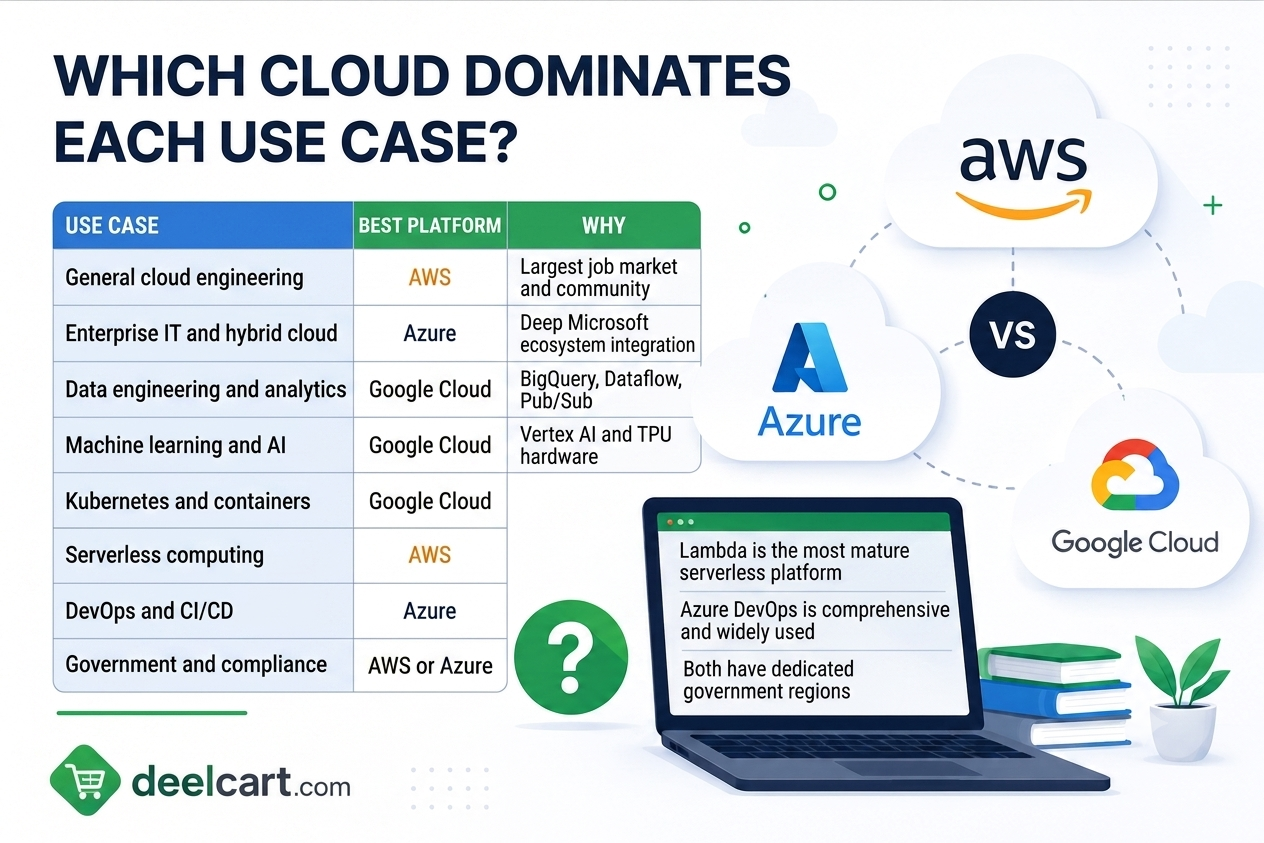
| Use Case | Best Platform | Why |
|---|---|---|
| General cloud engineering | AWS | Largest job market and community |
| Enterprise IT and hybrid cloud | Azure | Deep Microsoft ecosystem integration |
| Data engineering and analytics | Google Cloud | BigQuery, Dataflow, Pub/Sub |
| Machine learning and AI | Google Cloud | Vertex AI and TPU hardware |
| Kubernetes and containers | Google Cloud | Google invented Kubernetes — GKE is best in class |
| Serverless computing | AWS | Lambda is the most mature serverless platform |
| DevOps and CI/CD | Azure | Azure DevOps is comprehensive and widely used |
| Government and compliance | AWS or Azure | Both have dedicated government regions |
How to Choose Based on Your Situation
You are a complete beginner with no existing tech background
Start with AWS. The largest community means the most learning resources, the most answered questions online, and the most job postings to apply to once you have skills. The AWS Certified Cloud Practitioner is the most widely recognised entry-level certification.
You already work in IT at a company using Microsoft products
Start with Azure. Your existing knowledge of Windows Server, Active Directory, and Microsoft 365 gives you a head start. The AZ-900 and AZ-104 certifications are well-regarded at enterprise employers.
You want to work in data engineering or machine learning
Start with Google Cloud. BigQuery is the dominant data warehousing technology and widely used in data roles. Vertex AI is a leading managed ML platform. Google Cloud Professional Data Engineer is one of the most respected data certifications.
You already have a job and your employer uses one specific platform
Learn what your employer uses. Practical on-the-job experience on any cloud platform is worth more than any certification on a platform you only study theoretically.
You want to be a cloud architect or senior cloud engineer long term
Start with AWS to build your foundation — the breadth of services and size of the community gives you the widest exposure. Then add Azure or Google Cloud as a second platform. Senior architects at large organisations are expected to have multi-cloud knowledge.
Do Cloud Skills Transfer Between Platforms?
Yes — more than you might expect. The core concepts of cloud computing are the same across all three platforms:
- Compute — virtual machines, containers, serverless functions
- Storage — object storage, block storage, file storage
- Networking — virtual networks, load balancers, DNS, CDN
- Databases — relational, NoSQL, in-memory, data warehouses
- Identity and access management — users, roles, policies, permissions
- Monitoring — logging, metrics, alerting, tracing
Most experienced cloud engineers have working knowledge of at least two platforms. The first takes the longest to learn. Each subsequent platform takes a fraction of the time.
Recommended Learning Path for Each Platform
AWS Learning Path
Start with the AWS Certified Cloud Practitioner to get the big picture — what AWS is, how it is organised, and what the major services do. Then pursue AWS Certified Solutions Architect Associate — this is the most valuable certification for getting hired. After that specialise based on your interests — Developer Associate for software engineering, SysOps Administrator for operations, or move straight to Professional level for architecture roles.
Azure Learning Path
Start with AZ-900 Azure Fundamentals for the big picture. Then choose a role-based path — AZ-104 Administrator for infrastructure roles, AZ-204 Developer for software engineering roles, or AZ-305 Architect for architecture roles. Microsoft Learn provides free structured learning paths for every certification.
Google Cloud Learning Path
Start with Cloud Digital Leader for the overview. Then pursue Associate Cloud Engineer for the first technical certification. After that specialise — Professional Cloud Architect for broad cloud roles, Professional Data Engineer for data roles, or Professional Machine Learning Engineer for AI and ML roles.
Frequently Asked Questions
Is AWS harder than Azure or Google Cloud?
AWS has a steeper initial learning curve due to the number of services and inconsistent naming conventions. Azure is more intuitive for people with Microsoft background. Google Cloud has the cleanest interface. That said all three require significant study for certifications and professional competency — the difficulty differences are minor compared to the overall investment required.
Can I get a cloud job without a certification?
Yes but certifications significantly improve your chances, especially for entry-level roles where you lack hands-on experience. A certification proves to employers that you have foundational knowledge and are serious about the field. Most cloud hiring managers view AWS Solutions Architect Associate or Azure Administrator as a meaningful signal for junior candidates.
How long does it take to learn a cloud platform?
For a foundational certification like AWS Cloud Practitioner or AZ-900, expect 4 to 8 weeks of consistent study. For a first associate-level technical certification like Solutions Architect Associate or AZ-104, expect 2 to 4 months of consistent study combined with hands-on practice. These timelines assume 1 to 2 hours of study per day.
Should I learn multi-cloud from the start?
No. Focus on one platform until you have a solid foundation and ideally your first certification. Trying to learn all three simultaneously dilutes your focus and extends the time to your first job. Learn one platform deeply, get certified, and gain real experience. Multi-cloud knowledge comes naturally after that.
Is Google Cloud worth learning if it has lower market share?
Yes — for the right roles. If your target is data engineering, machine learning, or analytics, Google Cloud skills are highly valued and the smaller candidate pool means less competition for those roles. Google Cloud is not the best first choice for general cloud engineering, but it is the best first choice for data-focused careers.
Do AWS skills expire?
AWS certifications expire after three years. The underlying skills do not expire but cloud platforms evolve quickly — services change, new ones appear, and best practices shift. Regular hands-on practice is more important than recertification for keeping skills current.
Justin is a self-taught developer who builds and runs DeelCart himself — from the articles to the server it runs on. He manages his own Linux infrastructure and writes guides based on tools and workflows he actually uses day to day.